

Renesas expands auto MCU portfolio for vehicle control and safety applications
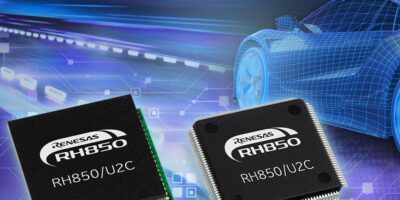
Renesas has announced the RH850/U2C, a new 32‑bit automotive microcontroller (MCU) built on a 28nm process. The MCU targets a diverse range of automotive applications, including chassis and safety systems for passenger cars and motorcycles, battery management systems (BMS) and body control functions such as lighting and motor control, and other general-purpose ASIL D applications.
The new device extends Renesas’ popular RH850 lineup as a low-end option, complementing the high-end RH850/U2B and mid-range RH850/U2A products. The RH850/U2C combines four RH850 CPU cores operating at up to 320 MHz (including two lockstep cores), with up to 8 MB of on-chip flash memory. Developers currently using RH850/P1x or RH850/F1x devices can smoothly transition to the new MCU to meet the requirements of the latest E/E architectures.
The RH850/U2C operates with interfaces designed for modern E/E architectures, such as Ethernet 10base-T1S, Ethernet TSN (1Gbps/100Mbps), CAN-XL, and I3C. It also maintains full compatibility with commonly used interfaces today, such as CAN‑FD, LIN, UART, CXPI, I²C, I²S, and PSI5. This comprehensive interface support enables mixed operation with existing ECUs and facilitates a smooth, phased migration across generations. As more vehicle networks transition to domain- and zone-based architectures, the RH850/U2C provides flexible system configuration and scalability, reducing network design complexity.
The MCU supports functional safety up to ASIL D, conforming to ISO 26262. To meet modern cybersecurity requirements, the device complies with the latest ISO/SAE 21434 standard and supports cryptographic algorithms ranging from post‑quantum cryptography (PQC) to those mandated by current Chinese and other international regulations. Its dedicated hardware accelerators provide high throughput by offloading cryptographic processing and reducing CPU load.
Built on a proven 28 nm manufacturing process, the RH850/U2C consumes significantly lower power in both active and standby modes. A dedicated standby mode further reduces power usage during deep stop and intermittent operation. These low‑power modes increase power‑design margins and reduce thermal demands so that systems remain compliant as environmental regulations tighten.