

u-blox GNSS technology powers next-gen telescope array in search for extraterrestrial intelligence
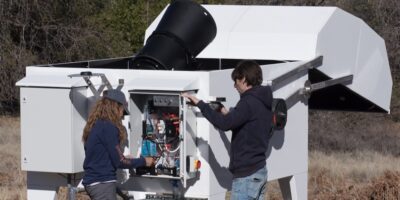
u-blox has announced that its ZED-F9T high-precision GNSS receiver is enabling sub-nanosecond synchronisation in an advanced telescope array used in optical Search for Extraterrestrial Intelligence (SETI) research.
The results have been achieved for the SETI program called PANOSETI (Pulsed All-sky Near-infrared Optical SETI), a multi-institutional scientific initiative involving researchers at the University of California, Berkeley, and other leading institutions, where precise time synchronisation across distributed telescope arrays is critical.
PANOSETI is designed to detect fast-transient optical and near-infrared signals across the entire observable sky, with the goal of identifying potential technological signatures or astrophysical phenomena. Achieving this requires extremely precise time synchronisation between widely distributed telescope nodes.
By leveraging GNSS-based differential timing with the u-blox ZED-F9T, the PANOSETI team demonstrated:
~0.7 nanosecond standard deviation between 1PPS signals over a 1 km baseline
Improved performance down to ~200 picoseconds using filtering techniques
This level of accuracy meets, and in some cases exceeds the requirements for next-generation distributed sensing systems.
The results highlight a key benefit of GNSS-based timing: high-precision timing can be achieved in environments where fibre infrastructure is unavailable, impractical or excessively costly.
These results show the capabilities that GNSS timing offers, not only for scientific research, but also for a range of other emerging applications, such as distributed sensor networks, remote timing systems and resilience of critical infrastructure, also in remote locations.