

Infineon introduces rad-hard GaN HEMT driver for satellite and hi-rel space applications
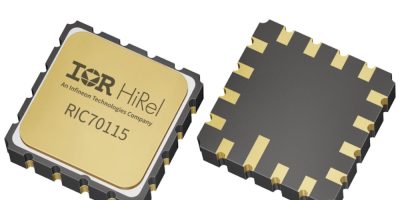
Infineon has introduced the RIC70115, a radiation-hardened (rad hard) gallium nitride (GaN) high-electron mobility transistor (HEMT) driver designed for satellite and high-reliability space applications where power conversion performance and long-term operational integrity are critical requirements. The RIC70115 supports both silicon (Si) and GaN MOSFET designs in low-side and high-side configurations, giving power system designers greater flexibility to adopt GaN-based power architectures in space platforms without compromising safe operation across varying bias voltage conditions. As the New Space economy continues to scale and satellite constellations grow in complexity and number, demand for rad hard power components that support the transition from silicon to GaN is increasing.
The RIC70115 integrates an independent Miller Clamp function that prevents parasitic-induced turn-on while maintaining the desired switching speed, reducing switching losses and improving overall efficiency. A Truly Differential Input (TDI) logic stage delivers high noise immunity by rejecting common-mode noise and mitigating the effects of electromagnetic interference and radio frequency interference, both particularly relevant in the electrically demanding environment of a satellite power bus. An integrated low dropout regulator (LDO) generates a tightly regulated 4.8 V drive voltage from a 5 V or 12 V source, reducing the need for external regulation components and supporting a power input range of 4.75 V to 15 V. Together, these integrated functions reduce external component count, simplify circuit design, and improve system reliability in high-cycle space power applications.
The RIC70115 meets the requirements of MIL-PRF-38535 across an extended operating temperature range of -55°C to 125°C. It is radiation hardened to a Total Ionising Dose (TID) rating of up to 100 krad (Si) and has been characterised for Single Event Effects (SEE) up to a Linear Energy Transfer (LET) of 81.9 MeV·cm²/mg, providing the radiation performance margins required for low-earth orbit and beyond.