

FETs are AEC-qualified and increase ‘vision’ of lidar systems
Two eGaN FETs developed by Efficient Power Conversion (EPC) have received AEC Q101-qualification.
The EPC2206, and EPC2212 are both discrete transistors in wafer level chip-scale packaging (WLCS) with 80 and 100V DS ratings respectively.
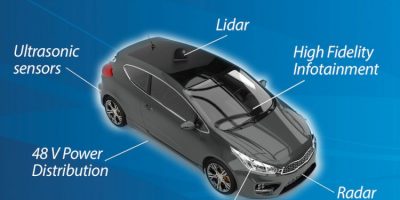
eGaN technology has been in mass production for over eight years, with EPC reporting successful field experience in automotive applications, such as light detection and ranging (lidar) and radar for autonomous cars, as well as in 48 to 12V DC/DC converters used in data centre computers, high fidelity infotainment systems, and high-intensity headlamps for lorries. The EPC2206 and EPC2212 have completed rigorous automotive AEC Q101 qualification testing and will be followed with several more discrete transistors and integrated circuits designed for the harsh automotive environment, says EPC.
The EPC2206 is an 80V, 2.2mOhm enhancement-mode FET with a pulsed current rating of 390A in a 6.1 x 2.3mm chip-scale package. The EPC2212 is a 100V, 13.5mOhm component with a pulsed current rating of 75A in a 2.1 x 1.6mm chip-scale package. These eGaN FETs are many times smaller and achieve switching speeds 10 to 100 times faster than their silicon MOSFET counterparts, claims EPC.
The EPC2206 is suitable for vehicles using 48V bus power distribution to manage the electronically-driven functions and features in today’s vehicles, such as electric start-stop, electric steering, electronic suspension, and variable speed air conditioning. EPC believes that with the emergence of self-driving vehicles, additional demands from systems such as lidar, radar, camera, and ultrasonic sensors are placed upon the power distribution system accelerating the need for automobiles to move to a 48V bus system to increase efficiency, while shrinking size and weight and to reduce system cost.
The EPC2212 can be used for firing the lasers in lidar systems because the FET can be triggered to create high-current with extremely short pulse widths. The short pulse width leads to higher resolution, and the higher pulse current allows the lidar system to discern objects at greater distances. The eGan FETs are also small and low-cost for use radar and ultrasonic sensors, in addition to lidar, in automotive applications.