

Menlo Micro cryogenic switches set new benchmark for RF switches
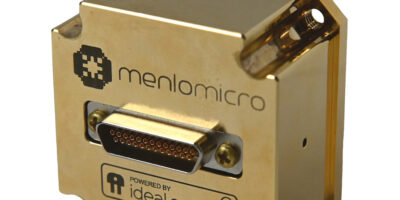
Menlo Microsystems has announced the launch of the MM4250 switch. This product is a cryogenic SP6T switch with a near zero thermal footprint used for the switching and control of high speed and RF signals with the dilution fridge of a quantum computer. By delivering high performance ohmic contact switching in cryogenic environments with a near zero thermal signature, the MM4250 addresses a critical bottleneck in superconducting qubit testing, quantum processor calibration, and high-precision cryogenic measurements.
The MM4250 has demonstrated exceptional capability in both quantum computing and cryogenic research, streamlining vector network analyser (VNA) calibration and measurement-uncertainty evaluation at cryogenic temperatures with a near zero thermal signature that does not alter the temperature with a dilution fridge.
Superconducting circuits and qubits require extremely low temperatures to maintain coherence and minimise noise. In space and astrophysics, VNA calibration at cryogenic conditions is essential for testing sensitive radio-frequency components such as low-noise amplifiers and detectors used in satellites and telescopes. Similarly, research in materials science and fundamental physics depends on precise microwave measurements at cryogenic temperatures to investigate novel materials and superconductors.
Traditional cryogenic switches can dissipate up to 2 watts of waste heat per activation, generating thermal loads that can raise the dilution fridge temperature by approximately 20 mK. This temperature rise causes significant delays of up to several hours while systems cool back to operating temperature. By contrast, the MM4250’s electrostatic actuation only consumes energy in the hundreds of nanoamps per switching operation, generating no appreciable waste heat and enabling a continuous test and calibration operation while at cryogenic temperatures.
The MM4250 toolkit enables traceable, turnkey RF scattering-parameter, large-signal, and noise-parameter measurements directly within research laboratories. This allows comprehensive characterisation of multiport RF components; interconnects spanning room to cryogenic temperatures; modulated signals; non-linear devices; and both cryogenic semiconductors and superconducting amplifiers.
Another major advantage of the MM4250 is its integrated calibration standards, which eliminate the need for the typically used external calibration components and free up more channels for device testing. In a typical 2-port VNA measurement setup, this efficiency shift means that the MM4250 can test more than twice as many devices at a time than alternative six-channel devices. Given that each cool-down and warm-up cycle can be multiple hours, the MM4250 delivers substantial time and energy savings while accelerating calibration and characterisation of quantum processors and other cryogenic components.