

Aerofugia and Sysgo advance certification ready avionics for the AE200-100 eVTOL
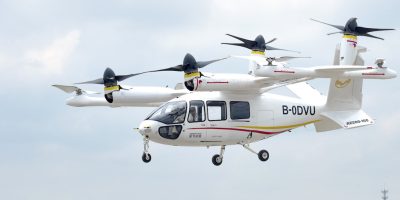
Aerofugia, an air mobility company developing next-generation electric vertical take-off and landing (eVTOL) aircraft, and Sysgo have announced their collaboration on the avionics platform for Aerofugia’s AE200-100 eVTOL programme.
The collaboration addresses one of the key engineering challenges facing the eVTOL industry: Consolidating a growing number of safety-critical and mixed-criticality functions onto powerful computing platforms while maintaining the isolation, deterministic behaviour and certification readiness required for commercial aviation.
The AE200-100 programme addresses this challenge through a partitioned avionics architecture based on ARMv8 technology and Sysgo’s PikeOS real-time operating system and hypervisor. The architecture enables applications with different levels of criticality to coexist on shared computing resources while maintaining strict spatial and temporal separation.
By consolidating functions that would traditionally require multiple dedicated computing units, the approach can reduce size, weight, power consumption and cost (SWaP-C), while establishing a scalable software foundation for future aircraft development.
Modern eVTOL aircraft must integrate flight control, electric propulsion, battery management, navigation, communications and health monitoring within increasingly compact computing environments. As more functions are consolidated, demonstrating their independence becomes a fundamental architectural and certification challenge.
Partitioned architectures based on concepts such as ARINC 653 enable applications of different criticality levels to share computing resources while maintaining defined temporal and spatial boundaries.
PikeOS combines a hard real-time operating system with separation-kernel and hypervisor functionality. This enables multiple applications and operating environments to execute independently on a common hardware platform and provides an architectural foundation for systems targeting high software assurance levels under DO-178C, including Design Assurance Level A (DAL A).
Commercial eVTOL programmes increasingly target multiple international markets. For the AE200-100, this means considering the requirements of the Civil Aviation Administration of China (CAAC), while international ambitions also make alignment with established global certification principles, including those applied by the European Union Aviation Safety Agency (EASA), an important consideration.
Using software technology with an established certification pedigree and reusable certification artefacts can reduce development risk and help avoid costly architectural changes later in a programme.
Security assurance is equally important as aircraft become increasingly connected. PikeOS’ separation-kernel architecture provides strong isolation between applications and is available with Common Criteria EAL5+ certification, complementing the functional safety requirements of safety-critical avionics platforms.
China’s rapidly developing low-altitude economy is accelerating the transition of eVTOL technology from demonstration aircraft toward commercially operated passenger platforms. As the market matures, aircraft manufacturers must address not only flight performance but also certification, maintainability and long-term platform evolution.
The AE200-100 programme demonstrates how hardware consolidation, mixed-criticality partitioning and certification-ready software architecture can work together to create a sustainable avionics platform.