

Microchip expands RT PolarFire FPGA portfolio with new spaceflight qualifications
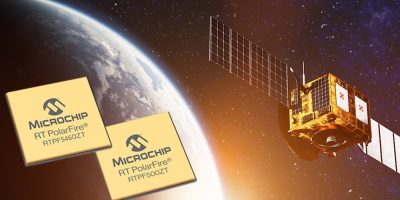
Microchip Technology has expanded the spaceflight qualifications of its radiation-tolerant (RT) PolarFire FPGA and SoC FPGA families, providing developers with additional options for high-reliability aerospace and defence systems.
The RT PolarFire FPGA RTPF500ZT has achieved Defense Logistics Agency (DLA) Qualified Manufacturers List (QML) Class V qualification, the highest qualification level for space microelectronics. The RT PolarFire SoC FPGA RTPFS460ZT has also completed QML Class Q and MIL-STD-883 Class B qualifications.
These milestones extend the range of qualified components available for space applications with stringent reliability and mission assurance requirements.
“As space applications demand greater onboard processing capability within increasingly constrained SWaP budgets, developers need technologies that maximise performance without increasing power consumption or thermal complexity,” said Shakeel Peera, corporate vice president of Microchip’s FPGA business unit. “Our RT PolarFire portfolio combines a power-efficient, radiation-tolerant architecture designed to be immune to radiation-induced upsets and defence-grade security to help developers reduce system power, simplify thermal management and build highly integrated, mission-critical space systems.”
Radiation-tolerant FPGA architecture for space applications
Many SRAM-based FPGAs require configuration scrubbing to detect and correct radiation-induced upsets. These events can occur between scrubbing cycles, potentially affecting system operation, while the scrubbing process can add to power consumption.
RT PolarFire devices use configuration technology designed to eliminate concerns associated with configuration single-event upsets (SEUs). Their power-efficient operation also helps address the thermal constraints of space platforms, while integrated security features are intended to protect mission-critical systems.
The RT PolarFire portfolio is designed for a range of aerospace and defence applications, including satellite payloads, satellite constellations, human-rated spacecraft and deep-space missions.
RTPF500ZT achieves QML Class V qualification
The RTPF500ZT RT PolarFire FPGA has achieved DLA QML Class V qualification. The device also features single-event latch-up (SEL) radiation performance and in-flight programmability, supporting mission-critical space applications where reliability and the ability to adapt hardware functionality in orbit are important.
QML Class V qualification provides assurance against the demanding quality and reliability requirements associated with spaceflight microelectronics.
RTPFS460ZT SoC FPGA completes QML Class Q and Class B qualification
The RTPFS460ZT RT PolarFire SoC FPGA combines programmable logic with an integrated microprocessor subsystem (MSS) featuring 64-bit RISC-V® processor cores.
The device has completed QML Class Q and MIL-STD-883 Class B qualifications, extending the available qualification options for developers working on high-reliability aerospace and defence systems.
The RTPFS460ZT development kit supports evaluation and prototyping. Both devices are supported by Microchip’s Libero® SoC Design Suite for FPGA design and development, while the Mi-V® ecosystem provides tools and resources for RISC-V development.
The common RT PolarFire architecture and development flow are intended to simplify evaluation, prototyping and the progression of designs towards flight hardware.
Understanding QML and MIL-STD-883 qualifications
MIL-STD-883 and the Qualified Manufacturers List (QML) programme establish testing, manufacturing and quality requirements for microelectronic devices used in high-reliability applications.
MIL-STD-883 defines environmental, mechanical and electrical test methods for microelectronic devices. QML Class V, under MIL-PRF-38535, establishes quality and reliability assurance requirements for space-level microelectronics. QML Class Q and MIL-STD-883 Class B provide qualification routes for other high-reliability applications.
These qualification frameworks help developers assess component suitability for systems where reliability and mission assurance are critical.
microchip-rt-polarfire-fpga-spaceflight-qualifications