

Microchip launches LX-820 radiation-tolerant oscillator for LEO satellites
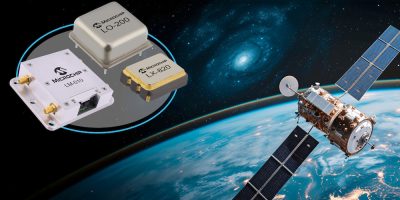
Microchip has expanded its L-Series timing portfolio with the LX-820 radiation-tolerant quartz oscillator, designed for Low Earth Orbit (LEO) satellites and other space applications.
The L-Series gives satellite developers a choice of oscillator architectures with different levels of frequency stability, phase noise, power consumption and package size to meet varying mission requirements. The portfolio is positioned between commercial off-the-shelf (COTS) timing components and traditional high-reliability space products.
Radiation-Tolerant Timing for Space Applications
Microchip’s L-Series combines commercial- or military-grade components with production inspection, electrical and thermal analysis and hybrid manufacturing processes. The oscillators have undergone Total Ionising Dose (TID) and Single-Event Latch-up (SEL) testing as complete, functioning devices, with radiation tolerance of up to 50 krad and SEL testing to 40 MeV·cm²/mg.
Most L-Series products also use swept quartz to help reduce radiation-induced frequency drift. The L-Series oven-controlled crystal oscillators (OCXOs) use ruggedised construction and four-point crystal mounts designed to withstand launch conditions and the intended mission environment.
Microchip says the L-Series is designed to address supply-chain and cost challenges associated with space-qualified timing components. While traditional high-reliability space timing solutions can involve long lead times and significant procurement costs, many L-Series configurations are available from stock or with lead times of less than 20 weeks.
The L-Series can also reduce programme costs by limiting the component pedigree, documentation and inspection requirements typically associated with traditional high-reliability space-grade timing products, depending on the mission’s qualification requirements.
LX-820 Supports CMOS and LVDS Outputs
The new LX-820 is housed in a compact 3.2 mm × 2.5 mm surface-mount package and operates across a temperature range of -55°C to +125°C.
The radiation-tolerant oscillator is designed to meet MIL-PRF-55310 Level B requirements and provides frequency stability of ±100 ppm. It supports CMOS output frequencies from 1.25 MHz to 135 MHz and low-voltage differential signalling (LVDS) output frequencies from 100 MHz to 250 MHz.
The combination of compact packaging, radiation tolerance and a wide frequency range makes the LX-820 suitable for timing applications where board space, environmental robustness and predictable clock performance are important.
L-Series Covers Multiple Space Timing Requirements
Satellite systems depend on accurate timing references for applications including communications, navigation, Earth observation and mapping, as well as emerging lunar missions. Different systems can have significantly different requirements for frequency stability, phase noise, power consumption, synchronisation and size.
Microchip’s L-Series includes crystal oscillators (XOs), temperature-compensated crystal oscillators (TCXOs), oven-controlled crystal oscillators (OCXOs) and a pulse-per-second (PPS) disciplined oscillator.
The portfolio allows developers to select an oscillator architecture according to application requirements. Compact XOs can address applications where size and broad frequency coverage are priorities, while TCXOs provide improved temperature stability with lower power consumption. OCXOs target applications requiring higher frequency stability and lower phase noise, while the PPS disciplined oscillator is intended for systems requiring synchronisation and holdover capabilities.
Microchip’s broader clock and timing portfolio spans miniature component oscillators, plug-in timing server cards, atomic clocks and multi-rack time-scale systems, providing timing solutions across a range of commercial, industrial and space applications.