

Pickering expands analog output portfolio for functional test and HIL
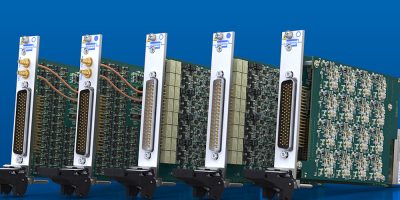
Pickering Interfaces has announced three new PXI/PXIe analog output modules, expanding its growing portfolio of signal sourcing and sensor simulation for functional and hardware-in-the-loop (HIL) applications.
The new modules span multi-channel waveform generation, precision digital-to-analog converter (DAC) outputs, and high-density thermocouple simulation, enabling engineers to stimulate embedded controllers with realistic analog, sensor, and waveform conditions from compact, open-platform test systems. Designed for high channel density in a single PXI/PXIe slot, broad chassis compatibility, and comprehensive driver support, the modules help engineers build capable automated test systems while reducing rack space, system complexity, and long-term obsolescence risk.
The 41-770 PXI and 43-770 PXIe DAC modules provide up to four fully isolated analog output channels in a single 3U PXI/PXIe slot. Each channel is independently programmable across multiple voltage and current ranges, with voltage outputs up to ±40 V and current outputs up to ±20 mA. The modules can also simulate open-circuit conditions, enabling engineers to replicate real-world failure modes such as faulty wiring or sensor failure for fault-injection testing. A hardware interlock feature provides additional protection for the device under test and the wider test system.
The 41-625 PXI and 43-625 PXIe multi-channel waveform generators provide up to 32 independent output channels in a single 3U PXI/PXIe slot. The modules support waveform generation from DC to 300 kHz, making them well-suited to simulate signals from real-world accelerometers and other multi-channel stimulus conditions. Each channel can store waveforms in independent memory blocks, supporting sine waves, standard waveforms, or customer-defined arbitrary waveforms, with instantaneous frequency adjustment under software control using Direct Digital Synthesis (DDS). Trigger functions allow events from other instruments to initiate waveform generation or frequency sweeps.
The PXI 41-761A analog output/thermocouple simulator modules are a dedicated, purpose-built solution for simulating thermocouple sensor outputs with precise µV-level resolution and built-in fault insertion. It provides independently isolated, two-wire low-voltage outputs that cover the output ranges of the most common thermocouple types, supports multiple cold junction configurations, and correctly handles common-mode voltages for true sensor-level simulation. With up to 32 fully isolated channels per slot, no external switching or system expansion required—delivering the industry’s highest thermocouple simulation density in a single PXI slot.
Designed for HIL simulation, functional test, sensor simulation, production test, and fault injection, these modules enable software-controlled electrical stimulus of embedded controllers and devices under test (DUT), eliminating the need for physical sensors, environmental chambers, or manual fault setups. For slot-constrained PXI and PXIe systems, they consolidate signal generation, sensor simulation, switching, and interconnect within a single modular signal-path architecture.
Drivers are available for both Windows and Linux operating systems, with a driver API supported in multiple programming languages, including C, Python, C#, MATLAB, Simulink, and LabVIEW, as well as a Soft Front Panel to simplify development and debugging. PXI and PXIe variants are available, including with PXI modules that integrate into standard PXI and Pickering LXI/USB chassis, enabling engineers to build sustainable, long-lifecycle test architectures on open, industry-standard platforms.