

Rohm launches new top-side cooling package for SiC MOSFETs
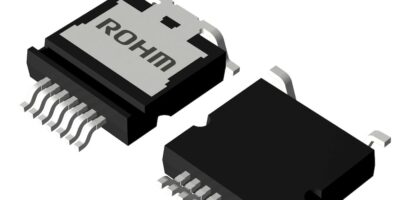
Rohm has developed the TSC3PAK (14.00 × 18.58 × 3.50mm) package for SiC MOSFETs. By adopting a top-side heat dissipation structure that places the heat dissipation surface on the top of the package, the new product enables automated mounting while achieving heat dissipation performance comparable to that of conventional through-hole packages (TO-247-4L). This contributes to greater efficiency and reliability in power conversion circuits for onboard chargers (OBCs) and electric compressors used in xEVs (electric vehicles).
In xEVs, the adoption of SiC devices is expanding beyond main inverters to include power conversion circuits such as OBCs and electric compressors to improve charging speed and extend cruising range. SiC devices are also increasingly being used in industrial equipment, including high-performance server power supplies and PV inverters, where high-efficiency operation is required.
Conventional SiC devices have generally relied on through-hole packages, which provide excellent heat dissipation during high-power operation. However, through-hole type devices involve manual mounting processes, and their form factor makes it difficult to achieve a lower package profile. Against this backdrop, surface-mount SiC devices compatible with automated mounting have begun gaining adoption. To address these issues, the new TSC3PAK delivers heat dissipation performance comparable to through-hole technology such as TO-247 in a surface-mount package.
The new package incorporates Rohm’s proprietary groove structure to secure a creepage distance of 6.66mm, allowing it to accommodate an AC peak voltage of 1200 V in a Pollution Degree 2 environment while maintaining compatibility with products widely adopted in the market. By enabling safe insulation design in high-voltage applications, the TSC3PAK also contributes to reduced mounting costs and higher reliability.
Products using the new package incorporate Rohm’s 4th Generation SiC MOSFETs, achieving low ON resistance and high-speed switching characteristics. As a result, switching losses during power conversion are significantly reduced, contributing to greater application efficiency and lower power consumption.