

Spectrum adds FPGA-based averaging to 59xx digitisers
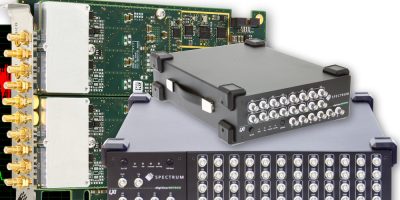
Spectrum Instrumentation has introduced an optional firmware feature that enables its 59xx series high-resolution digitisers to perform onboard summation averaging. By processing waveforms directly in the onboard FPGA, the feature reduces noise and improves signal-to-noise ratio (SNR), while significantly reducing the volume of data that needs to be stored or transferred for analysis.
The new option supports averaging at rates of up to 2 million events per second, making it suitable for high-repetition-rate signals and applications where low-level pulses or signal details are obscured by noise.
Onboard averaging is available for all 52 models in the 59xx series, which includes PCIe cards and standalone Ethernet (LXI) instruments.
Potential applications include mass spectrometry, lidar, radio astronomy, industrial automation, radar, biomedicine, nuclear physics, communications and sonar.
16-bit digitizers for multi-channel data acquisition
The 59xx series comprises 24 PCIe card variants and 28 Ethernet-based instruments. The digitisers offer real-time sampling rates from 5 MS/s to 125 MS/s, 16-bit resolution and a range of channel configurations.
PCIe models provide between one and eight input channels per card, while standalone instruments offer between four and 48 channels. Using Spectrum’s proprietary Star-Hub system, multiple PCIe cards can be synchronised to create acquisition systems with up to 128 channels.
The PCIe cards can stream acquired data to PCs or GPUs over the host bus at rates of up to 700 MB/s.
How summation averaging improves signal quality
Summation averaging is a time-domain processing technique that combines repeated acquisitions of a signal to reduce random, uncorrelated noise. When the signal is repetitive and the noise is random, averaging can improve SNR and help reveal signal features that would otherwise be obscured.
In one example, a low-level signal of approximately 300 µV is acquired using an M2p.5962 digitiser sampling at 125 MS/s. In the original acquisition, the signal is buried in random noise. Averaging eight acquisitions reveals three pulses occurring at intervals of 3.6 µs. Averaging 64 acquisitions improves signal clarity further, revealing a pulse with an amplitude of approximately 300 µV and smaller subsequent pulses.
Ideally, when noise is uncorrelated between acquisitions and the signal remains consistent, averaging (N) measurements improves SNR by a factor proportional to (\sqrt{N}). Averaging 64 acquisitions can therefore provide an SNR improvement of up to approximately 18 dB, equivalent to around three additional effective bits under ideal conditions.
The feature can help users extract more information from the 59xx series’ 16-bit measurements, although the actual improvement depends on the signal, noise characteristics and acquisition conditions.
The new firmware option, designated M2p.xxxx-spavg, is available immediately for new 59xx series digitizers and can also be installed as a field upgrade on existing units.