

Toshiba launches power MOSFETs to boost efficiency in automotive applications
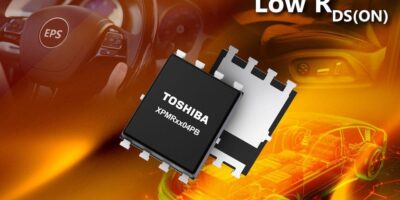
Toshiba has announced the launch of three new 40V N-channel power MOSFETs: the XPMR5904PB available now, and the XPMR7404PB and XPMR8504PB, which will become available shortly. These devices use the newly adopted SOP Advance(EWF) package and are designed for demanding automotive applications, including inverters, semiconductor relays, load switches, and motor drives.
The defining characteristic of the XPMR5904PB is the integration of the SOP Advance(EWF) package, which employs a post-less structure that connects the chip and outer lead via a copper clip rather than internal posts. This architectural change eliminates internal posts and significantly reduces the resistance of the current path. Furthermore, the device incorporates a source-coupled structure that connects the source terminals on the reverse side of the package, increasing the contact area with the PCB land pattern. This internal structural optimisation expands the mountable chip area. It also improves current-carrying capability, enabling the XPMR5904PB to achieve a drain current (DC) rating of 180A, 1.2 times that of existing products using similar SOP Advance(WF) packaging.
Performance metrics have been significantly improved to meet high-current automotive requirements and enhance energy efficiency. Compared with the existing XPHR7904PS, the XPMR5904PB delivers an approximate 25% reduction in drain-source on-resistance (RDS(ON)) alongside an approximate 38% reduction in channel-to-case thermal impedance (Zth(ch−c)). These enhancements contribute directly to lower power loss and higher efficiency in automotive equipment.
To support manufacturing reliability and inspection processes, the SOP Advance(EWF) is a surface-mount package designed with a wettable flank structure. This design ensures high visibility of the solder fillet, making it easier to confirm mounting conditions using automated optical inspection (AOI) equipment. This feature automates inspection processes on manufacturing lines and ensures devices meet the rigorous quality requirements of the AEC-Q101 reliability test standard for automotive electronic components.