

Tria Technologies launches module with new generation Intel processor
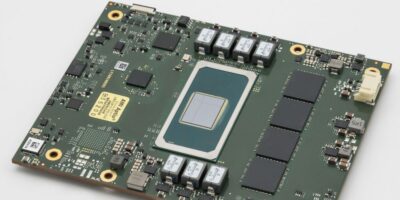
Tria Technologies has launched the new COM-HPC Client Computer-on-Modules (CoM) product, powered by the Intel Core Ultra Processors (Series 3).
As Tria’s first product to incorporate Intel’s new-generation processors, the new module is purpose-built for demanding AI at the Edge applications in automation and robotics where high performance and ultimate reliability are critical. The multiple benefits include AI performance, coupled with fast response times.
The new COM-HPC Client Size A module sets a new standard for embedded computing performance with up to sixteen cores and an integrated AI accelerator (NPU). This advanced platform supports up to 64GB of high-speed LPDDR5x SDRAM with IB-ECC for enhanced reliability, and harnesses Intel Xe graphics with up to 12 Xe cores for superior visual performance.
Developed for design engineers and system architects, the new module features a fully integrated AI accelerator (NPU). Alongside Intel Xe graphics with up to 12 Xe cores, it achieves industry-leading AI performance of up to 180 trillion operations per second (TOPS).
Tria’s COM-HPC allows for compact and cost-efficient Edge solutions with no need for external PCIe based accelerators or cloud-based AI services. It also enables AI applications to run in a controlled environment and can act as a substitute for GfX accelerators in medical, spectroscopy, data analysis and gaming applications as well as automation and robotics applications,
Offering versatile display outputs, it supports four independent display streams available from different display interfaces including DisplayPort/HDMI, embedded DisplayPort and USB-C. For high-bandwidth I/O extensions system designers can utilise multiple PCI Express Gen 5 and Gen 4 lanes, a large variety of USB4, USB 3.2 and USB 2.0 ports, plus network and SATA storage options.
With Trusted Platform Module TPM 2.0 and a commitment to long-term product availability, this module is an ideal choice for demanding applications requiring robust performance, security, and longevity. Furthermore, the product design allows the board to operate in environments with extended temperature ranges.